Metal Detector vs. X-Ray Inspection: Which System Is Right for Your Process?
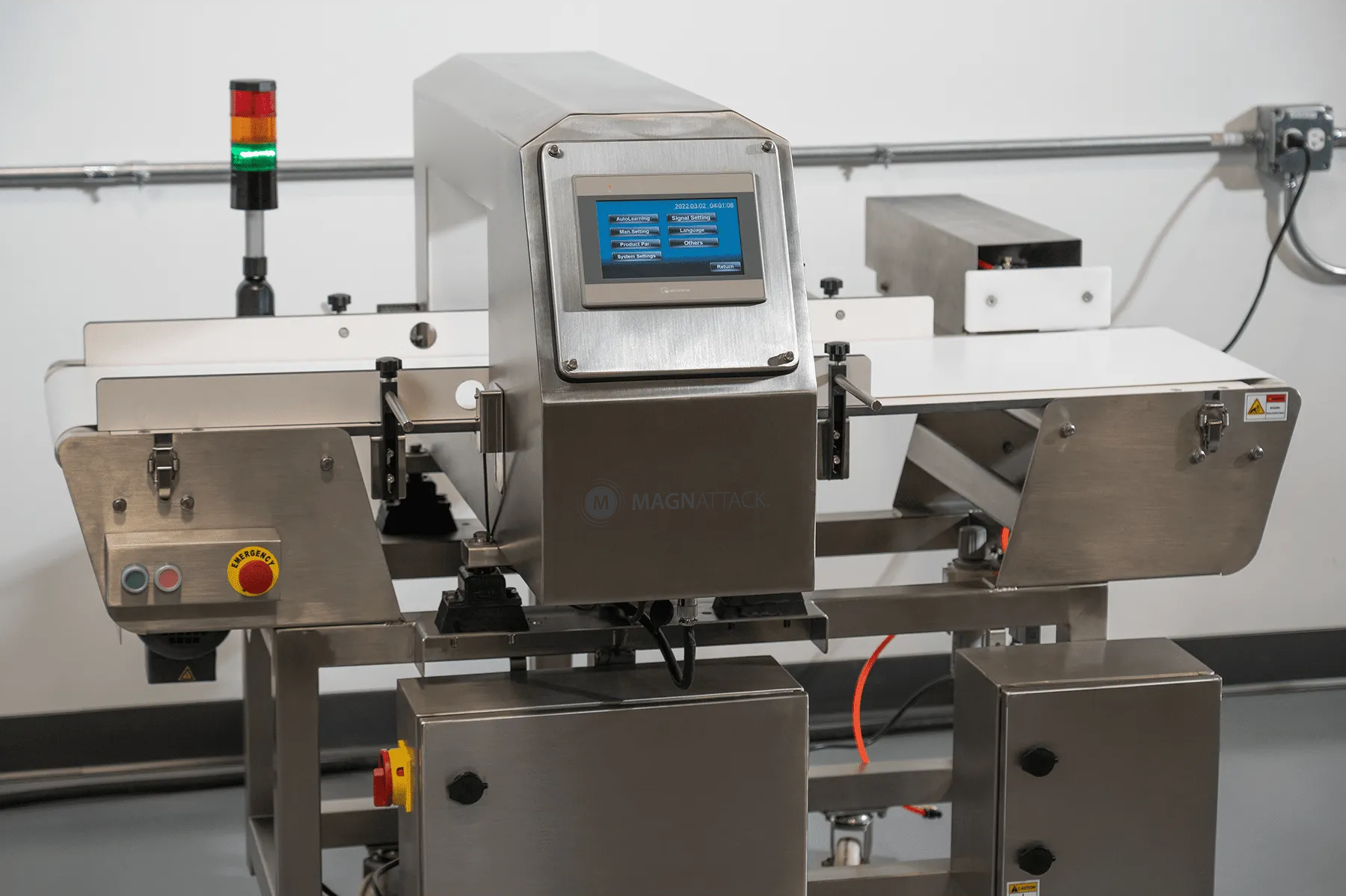
When selecting food inspection equipment, manufacturers are often faced with an important question: should they invest in a metal detector or an X-ray inspection system?
Both technologies play a critical role in foreign material detection and are widely used within modern food inspection systems. However, they are designed to identify different contaminants and offer different benefits depending on your product, process, and contamination risks.
Understanding how each technology works can help food manufacturers improve food safety, strengthen HACCP programs, and reduce the likelihood of foreign material contamination reaching consumers. This is particularly important in industries such as baking, ingredient processing, dairy, and pet food manufacturing, where effective foreign material control plays a critical role in product safety and quality.
How Metal Detection Works
Industrial food metal detectors use electromagnetic fields to identify metallic contaminants passing through the inspection aperture.
A properly configured metal detector can detect:
- Ferrous metals
- Non-ferrous metals
- Stainless steel contaminants
- Broken machinery fragments
- Fasteners, screws, nuts, and bolts
- Wire contamination
Food metal detectors remain one of the most widely used types of food inspection equipment because they provide reliable contaminant detection while remaining cost-effective and easy to integrate into production lines.
Advantages of Metal Detection
- Lower capital investment
- High inspection speeds
- Proven and reliable technology
- Easy integration into existing production lines
- Low operating costs
- Effective detection of metallic contaminants
Limitations of Metal Detection
While highly effective at detecting metal contamination, metal detectors cannot identify:
- Glass
- Stone
- Bone
- Ceramics
- Most plastics
- Rubber
If these contaminants present a risk within your production process, additional food inspection systems may be required.
It is also important to note that metal detector sensitivity can be influenced by several factors, including product characteristics, aperture size, operating frequency, contaminant orientation, and environmental conditions. For this reason, inspection performance should always be validated under actual production conditions.
By pairing magnetic separators with metal detectors, food manufacturers can implement a layered contamination control strategy that improves foreign material detection, reduces contamination risks, and strengthens overall food safety performance.
What Is Product Effect?
Certain food products can interfere with a metal detector’s electromagnetic field. This phenomenon, known as product effect, is commonly associated with products that contain high levels of moisture, salt, or minerals.
Examples include:
- Cheese
- Meat products
- Poultry
- Sauces
- Wet pet food
Product effect can make contaminant detection more challenging in some applications. In these situations, manufacturers may evaluate additional inspection technologies, such as X-ray inspection, to complement their foreign material control strategy.
How X-Ray Inspection Works
Unlike metal detectors, X-ray inspection systems identify contaminants by analyzing density differences within a product.
As products pass through the inspection area, the X-ray system detects foreign materials based on their density relative to the food product itself.
X-ray inspection systems can often detect:
- Ferrous metals
- Non-ferrous metals
- Stainless steel
- Glass
- Stone
- Bone
- Ceramic
- Dense plastics
In addition to foreign object detection, many modern X-ray inspection systems can perform quality control checks such as:
- Missing product detection
- Fill-level inspection
- Seal integrity verification
- Product count verification
- Packaging inspection
These capabilities make X-ray inspection a powerful tool within a comprehensive contamination detection system..
When Is X-Ray the Better Choice?
While metal detectors are highly effective in many applications, X-ray inspection may be preferred when manufacturers need to detect contaminants such as glass, stone, bone, ceramic, or certain dense plastics.
X-ray systems can also be advantageous for products packaged in metallized film or foil, which may present challenges for metal detection.
In addition to foreign material detection, many X-ray systems can perform quality checks such as:
- Fill-level inspection
- Missing product detection
- Seal integrity verification
- Product counting
- Package integrity inspection
For manufacturers looking to combine food safety and quality control within a single inspection point, X-ray inspection may offer additional advantages.
Metal Detector vs. X-Ray: Key Differences
| Feature | Metal Detector | X-Ray Inspection |
|---|---|---|
| Detects metal | Yes | Yes (aluminum is better found by metal detection) |
| Detects glass | No | Yes |
| Detects stone | No | Yes |
| Detects bone | No | Yes (calcified bone) |
| Detects dense plastics | No | Often |
| Product quality inspection | Limited | Extensive |
| Initial investment | Lower | Higher |
| Operating complexity | Lower | Higher |
Foreign Material Detection Requires More Than One Control Point
Many manufacturers approach metal detection and X-ray inspection as competing technologies. In reality, both can play an important role within a broader foreign material control strategy.
An effective contamination detection system may include:
- Raw material inspections
- Magnetic separation
- Metal detection
- X-ray inspection
- Checkweighing
- Quality assurance inspections
By implementing multiple control points throughout production, food manufacturers can significantly improve foreign material detection and reduce the likelihood of contaminants reaching finished products.
Which System Is Best?
There is no universal answer.
For many applications, food metal detectors provide an effective and economical solution for identifying metallic contaminants, particularly when paired with magnetic separators.
However, facilities that face risks from glass, bone, stone, ceramic, or dense plastic contamination may benefit from the broader detection capabilities offered by X-ray inspection systems.
Many manufacturers ultimately implement both technologies as part of their overall food contamination prevention strategy. Rather than choosing one technology over another, facilities often establish multiple layers of protection throughout production.
The Magnattack Perspective
Many food manufacturers focus on selecting a metal detector or X-ray system, but effective foreign material control often requires more than a single inspection technology.
At Magnattack, we advocate for a layered contamination control strategy that combines magnetic separation, metal detection, X-ray inspection, checkweighing, and quality assurance practices where appropriate. By establishing multiple control points throughout production, manufacturers can improve contaminant capture, reduce risk, and strengthen overall food safety performance.
This approach is particularly valuable in industries such as baking, dairy, ingredient processing, and pet food manufacturing, where contamination risks can arise at multiple stages of production.
Frequently Asked Questions
Can a metal detector detect stainless steel?
Yes, although stainless steel is generally more difficult to detect than ferrous metals due to its lower magnetic permeability and electrical conductivity.
What can X-ray inspection detect that metal detectors cannot?
X-ray inspection systems can often detect glass, stone, bone, ceramic, and certain dense plastics in addition to metallic contaminants.
Is X-ray inspection safe for food?
Yes. Food inspection X-ray systems are designed to inspect products without affecting product quality or making food radioactive.
Should food manufacturers use magnetic separators with metal detectors?
In many applications, magnetic separators and metal detectors are used together as part of a layered contamination control strategy. Magnetic separators can remove ferrous contamination earlier in the process, while metal detectors provide an additional level of inspection before products reach consumers.
Conclusion
Whether you’re investing in food metal detectors, X-ray inspection systems, or a combination of technologies, the most effective solution is one that aligns with your contamination risks and production requirements.
When incorporated into a broader foreign material detection program, modern food inspection equipment can help improve food safety, reduce recalls, support regulatory compliance, and strengthen consumer confidence.
Learn More
Not sure which inspection technology is right for your application?
The Magnattack team can help assess your product, process, contamination risks, and food safety objectives to determine the most appropriate combination of magnetic separation and inspection equipment for your operation.
Explore our Inspection Equipment range or contact our team for guidance on building a comprehensive foreign material control strategy.