Why Rare Earth Magnets Matter for Food Safety
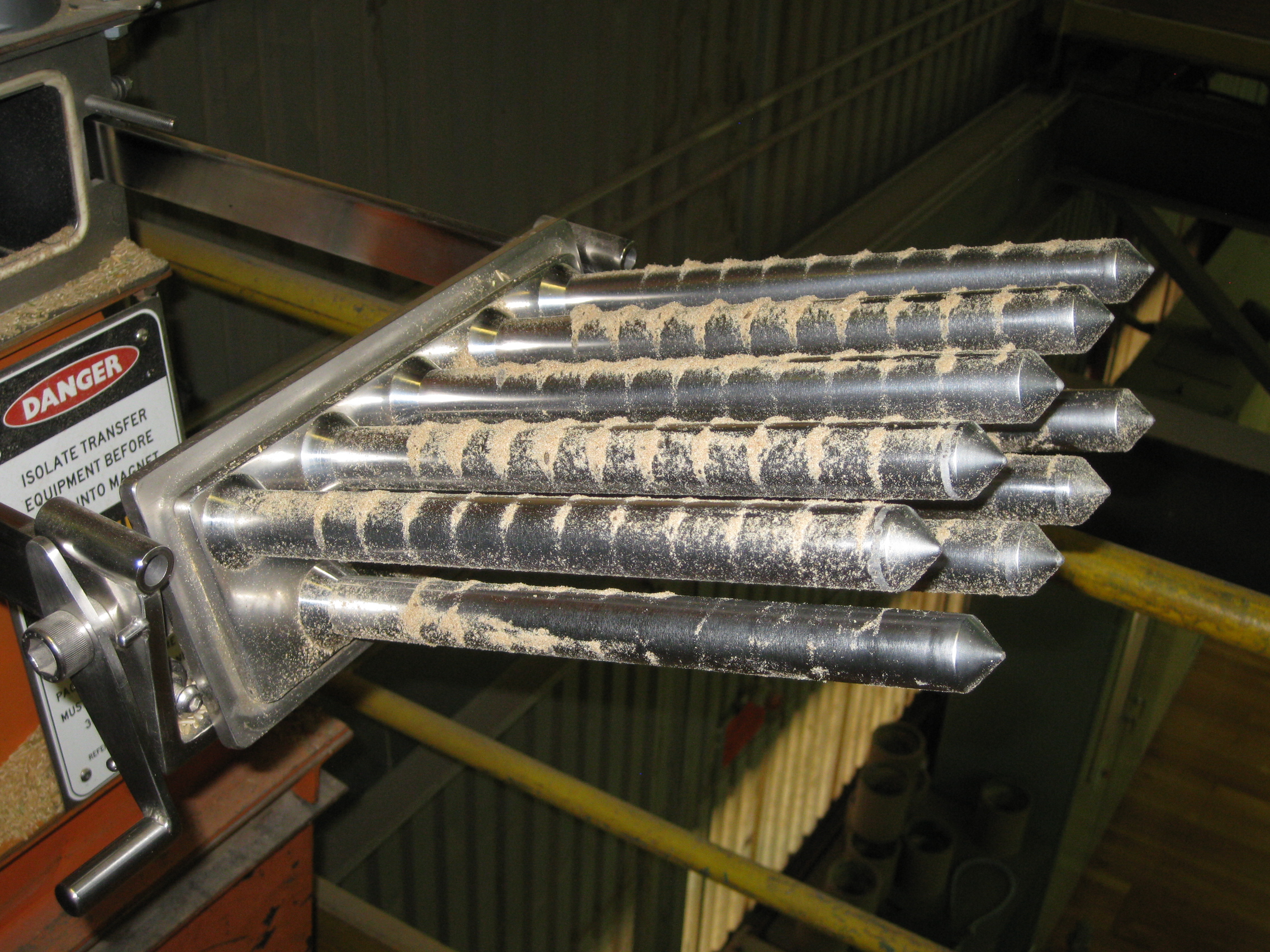
Food safety is non-negotiable. Yet one of the most overlooked contributors to contamination control is the performance of magnets used to remove metal fragments from a product stream. Not all magnets are created equal. The difference between using ceramic (ferrite) magnets and rare earth magnets can mean the difference between effective separation and costly contamination incidents.
This blog breaks down the science behind magnet types, explains why rare earth magnets deliver superior performance, and helps processors make smarter decisions to protect product quality, equipment and brand integrity.
Understanding the Basics: Ceramic vs. Rare Earth Magnets
What Are Ceramic (Ferrite) Magnets?
Ceramic magnets, also known as ferrite magnets, are made from a combination of iron oxide and barium or strontium carbonate. They are cost-effective, corrosion-resistant, and widely used in general industrial applications. However, their magnetic strength typically ranges only from 2,000 to 3,500 gauss which makes them less effective in demanding food processing environments.
What Are Rare Earth Magnets?
Rare earth magnets, specifically neodymium (NdFeB) and samarium cobalt (SmCo), are engineered for high-performance applications. They provide magnetic strength exceeding 10,000 gauss with deep and powerful magnetic fields resulting in superior performance in challenging processing conditions. Neodymium magnets, the most powerful commercial magnets available, are widely used in advanced food-grade magnetic separators.
Why Magnetic Strength Matters in Food Safety
Modern food processing environments introduce a wide range of contamination risks including fine ferrous particles, work-hardened stainless steel fragments and weakly magnetic fragments that are nearly impossible to detect with the naked eye. The only way to capture these threats effectively is by using high-strength magnets that can pull even faintly magnetic particles out of product streams.
Rare earth magnets provide the strength needed to:
- Capture work-hardened stainless steel particles (304 and 316 grades)
- Withstand fast-moving or thick product streams
- Reduce the need for downstream filtration or manual checks
- Prevent wear and damage to equipment caused by metal fragments
For facilities operating under HACCP or FSMA frameworks, rare earth magnets help meet critical control point (CCP) requirements with stronger, more consistent performance.
Applications Where Rare Earth Magnets Excel
Rare earth magnets are the gold standard for magnetic separation in food processing environments, especially in high-risk areas, such as:
- Grinders and Mixers: Where metal shavings and tool fragments can be introduced
- Pipeline Transfers: Especially in slurry, emulsion, or pumped products
- Dry Ingredient Hoppers: Where fine powders are vulnerable to stainless steel contamination
- Loadout and Packaging Lines: To ensure final product safety before shipment
They are particularly effective in demanding environments like meat and rendering operations, where product density, fat content and abrasion challenge weaker systems.
Cleanability and Hygienic Design Advantages
While ceramic magnets are corrosion-resistant, they often lack the sanitary design required for direct food contact environments. Rare earth magnets are housed in fully sealed stainless-steel housing making them easier to clean and more resistant to buildup from fats, proteins, and moisture.
Additionally, rare earth magnet systems, like the self-cleaning Mag-Ram®, can be designed to automatically purge collected contaminants, reducing downtime and labor requirements.
Key Design Features for Food Safety
- 316 stainless steel construction
- Welded, crevice-free housings
- Fully enclosed magnet bars
- Self-cleaning or easy-clean options
- USDA, FDA, and EHEDG compliant finishes
Explore magnetic separator options for beverage production. Ensure product purity and safety from receiving to bottling in breweries and wineries.
Cost vs. Performance: Why Rare Earth Magnets Are Worth It
It’s true that rare earth magnets carry a higher initial investment. However, the return on that investment is clear:
- Fewer contamination incidents and related costs
- Reduced equipment wear and maintenance
- Improved product quality and yield
- Shorter cleaning and inspection cycles
Facilities that rely on lower-strength magnets often upgrade only after failures, making the initial savings short-lived.
What Happens When Ceramic Magnets Fall Short
Consider a facility that relied on ferrite magnets in its flour line. During a routine inspection, stainless steel fragments were found in the finished product. The ferrite magnets had not captured these particles because their field strength was too weak to draw in low-magnetic materials embedded in fast-moving powder.
The incident led to product recalls, customer complaints, and costly brand damage. The facility later upgraded to rare earth magnetic grates and eliminated the issue.
This isn’t an isolated case. Many plants discover the limits of ceramic magnets only after a failure has occurred.
How to Evaluate Your Current Magnet Performance
If you’re unsure whether your current magnets are up to standard, ask these key questions:
- What is their Gauss rating? Anything below 9,000 Gauss may not be capturing fine particles effectively.
- Are contaminants consistently captured? Regular buildup should be visible.
- Is it part of your CCP plan? If yes, performance needs to be verified.
- Are you finding high levels of metal contamination downstream? If yes, additional upstream separation should be considered to offload the burden on your final magnets.
Testing magnet strength by performing regular gauss tests and documenting inspections are all essential for audit-readiness and quality assurance.
Make Rare Earth the Standard
For over 50 years, Magnattack continues to lead the way in magnetic separation innovation.
Our rare earth systems are engineered to meet the demands of modern food, dairy and meat processing while delivering unmatched strength, hygienic design and reliability.
Ready to reduce risk and strengthen your food safety program? Request a magnet audit or consultation today and ensure your operation is protected where it matters most.